Al Tavolo
Al Tavolo is a community table concept for Piazza Vecchia in Bergamo,Italy designed to create more opportunities for people of different generations to meet, share, and connect through everyday activities, local traditions, and community-led experiences.
We explored how a shared public space could make those interactions happen more naturally.
The Problem
Opportunities for meaningful connection across generations are becoming harder to find.
Our research suggested that age itself wasn't the primary barrier to connection. People naturally connect when they have a shared purpose, interest, or activity—but opportunities to make those connections are often scattered, informal, or difficult to access.
We set out to explore how Bergamo could create more opportunities for unexpected connection across generations.
Timeline
Completed as part of a Human Centered Design project at the Copenhagen Institute of Interaction Design (CIID)over a two week period.
Team
Julian Mößnang, Shaheen Shrestha, Taylor Haigler
The Approach
We used a human-centered research process to understand what enables—and prevents—intergenerational connection.
- Interviewed thirty people between 20 and 80 years old to understand how people currently build relationships across generations.
- Synthesized research into three key insights around shared purpose, recurring participation, and community infrastructure.
- Created personas representing younger working adults and older retired community members.
- Mapped the relationships between people, local culture, activities, community organizations, and public spaces.
- Used biomimicry to explore how resilient ecosystems create connection, exchange knowledge, and collectively maintain shared environments.
- Developed recommendations before translating the research into a tangible community experience.
Our research helped us identify three key insights.
- Connection starts with shared purpose
- People naturally form relationships when they share an interest, value, or goal. Practical experiences and reciprocal learning can create stronger connections than formal intergenerational programs.
- Relationships need repetition
- One-time events aren't enough to create lasting relationships. Frequent, informal interactions, recurring participation, and shared rituals give relationships the opportunity to develop over time.
- Places can create the conditions for connection
- Community organizations and public spaces already play an important role in bringing people together. Rather than creating an entirely new social program, we saw an opportunity to strengthen the infrastructure that already exists in Bergamo.
The Opportunity
Our research led to a new question:
How might we encourage interaction that is effortless, recurring, and playful so that we can reduce the existing gap between generations?
Instead of designing a program that explicitly tells different generations to interact, we explored how shared activities could make interaction happen naturally.
The Solution
Al Tavolo- A community table in Piazza Vecchia that acts as shared social infrastructure for Bergamo.
Rather than being tied to a single activity, Al Tavolo is intentionally flexible.
Local organizations and residents can use the table to create recurring community rituals—from cooking workshops and traditional recipe exchanges to storytelling, games, music, language learning, cheese tasting, collaborative art, and neighborhood projects.
The table becomes a physical platform for the community rather than a destination with a fixed purpose.
The space provides the invitation.
The community provides the activity.
The Experience
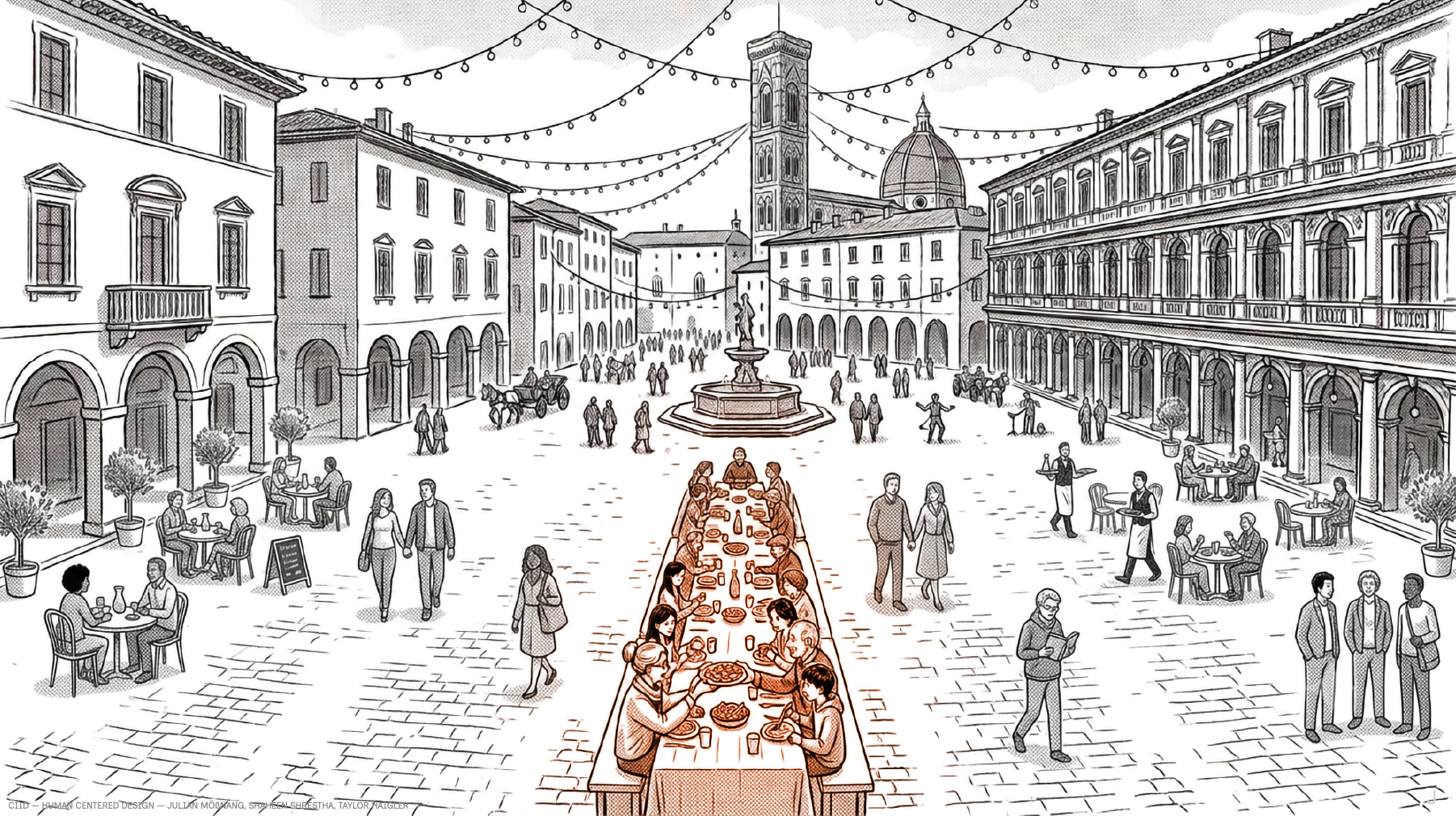
The final concept imagines Al Tavolo as a recognizable gathering point in Piazza Vecchia—an adaptable table that can support different activities throughout the week and evolve with the community.
Our concept imagery illustrates the table operating as part of the existing life of the piazza: surrounded by cafés, pedestrians, families, older residents, and visitors, while providing a dedicated place for people to gather and participate together.
Impact & Outcomes
Al Tavolo translates our research into a community-led service model rather than a one-off event.The concept:
- Creates a visible, accessible place for recurring interaction.
- Gives local organizations a platform to bring their existing activities into public space.
- Encourages connection through shared purpose rather than forced interaction.
- Creates opportunities for knowledge, traditions, and stories to move between generations.
- Positions public space as social infrastructure that can support belonging and community participation.
Because Al Tavolo was developed as a concept rather than implemented in Bergamo, these are intended outcomes rather than measured impact.
The Results
Al Tavolo reinforced an important principle for me as a designer: good community experiences don't necessarily require creating more programs—they can create the conditions for people and existing communities to do more together.
Our final concept evolved from a broad question about the generational divide into a more focused intervention: a shared physical space that local organizations and residents could continually activate.
The project ultimately became less about designing a table and more about designing the conditions for connection.